


Drop your phone once on concrete and you’ll understand why screen protection isn’t optional anymore. It’s the moment most people start searching for a gadget guard that can actually survive daily life not just marketing photos of a hammer bouncing off glass.
This guide breaks down what Gadget Guard products are, how they compare to other screen protection brands, what real users experience, and how to pick the right one for your device without wasting money on hype.
What Is a Gadget Guard?
Gadget Guard is a screen protection brand known for tempered glass screen protectors, phone cases, and related device accessories. Their products are designed to absorb impact and resist scratches so the actual screen underneath which is far more expensive to repair stays intact.
Most Gadget Guard screen protectors use layered tempered glass, sometimes paired with a “shatter guard” film underneath. The idea is simple: if the glass cracks, it cracks instead of your phone’s display, and the film keeps the shards from scattering.
That said, no screen protector makes a phone indestructible. A gadget guard reduces risk it doesn’t eliminate it. Anyone promising 100% unbreakable protection is stretching the truth, and it’s worth being skeptical of that kind of claim.
Why People Buy Screen Protectors in the First Place
Before comparing brands, it helps to be clear on what problem you’re actually solving. Most buyers fall into one of these categories:
- Scratch prevention – daily pocket lint, keys, and sand can dull a screen over months.
- Drop protection – tempered glass absorbs shock better than bare glass alone.
- Resale value – a scratch-free screen matters a lot when trading in or selling a used phone.
- Peace of mind – for parents handing phones to kids, or anyone accident-prone.
If your main concern is scratches, almost any decent tempered glass will do the job. If you’re worried about drops, thickness, hardness rating, and edge coverage matter a lot more.
How Gadget Guard Compares to Other Brands
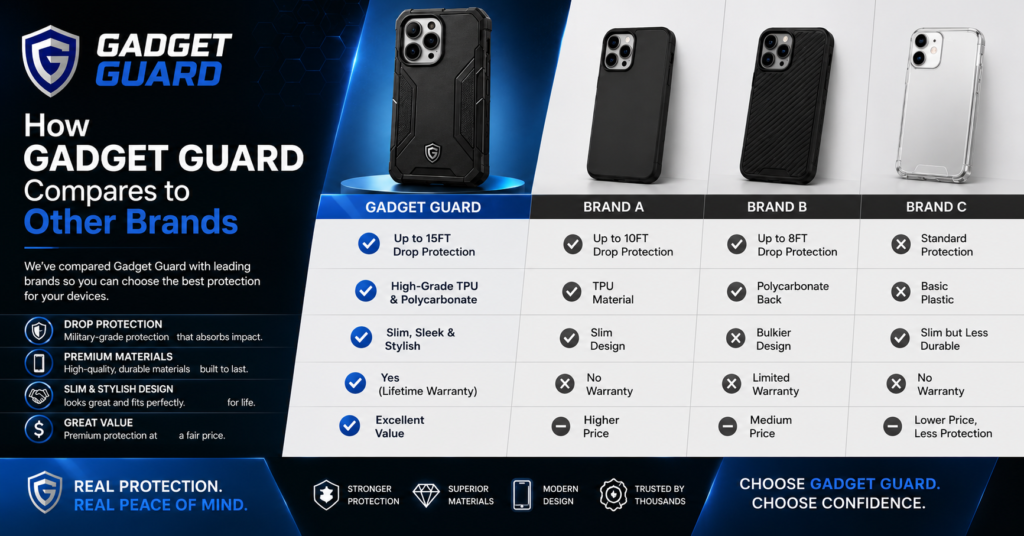
There’s no shortage of screen protector brands — ZAGG, Spigen, Amazon Basics, and Gadget Guard all compete in a similar price range. Here’s a general comparison based on commonly reported product specs and user feedback, not lab-tested numbers, since exact hardness and impact data vary by device model and generation.
| Feature | Gadget Guard | ZAGG InvisibleShield | Spigen Glas.tR | Generic Tempered Glass |
|---|---|---|---|---|
| Material | Tempered glass / hybrid film | Glass and film hybrid options | Tempered glass | Tempered glass |
| Typical price range | Mid-range | Mid to premium | Mid-range | Budget |
| Warranty | Often includes device protection plans on select lines | Limited lifetime warranty on some products | Limited warranty | Rarely included |
| Install ease | Moderate, some models need alignment tray | Similar | Generally easy | Varies widely |
| Best for | Users wanting an added device warranty option | Users wanting brand reliability | Budget-conscious buyers wanting decent quality | Extreme budget buyers |
A quick note on warranties: some Gadget Guard product lines have offered protection plans that go beyond just the screen protector, covering certain damage to the device itself. Terms and availability change often, so always check the current warranty details directly on the product listing or manufacturer’s page before buying don’t assume older terms still apply.
Types of Screen Protection to Know
Tempered Glass
The most common option. Multiple layers of glass are treated to be harder and more shatter-resistant than a single sheet. Good balance of clarity, touch sensitivity, and protection.
Hybrid Film Guards
These combine a plastic film base with a thin glass or hard-coated layer. They tend to be more flexible, which helps on curved-edge phones, but usually offer slightly less scratch resistance than pure tempered glass.
Case + Screen Combo Kits
Many gadget guard kits now bundle a case with a matching screen protector, since drops often hit the corners and edges as much as the screen face. If you’re buying protection for a new phone, a bundle is usually better value than buying pieces separately.
People can also read this: Walmart Self-Checkout Removal What’s Really Happening in 2026
How to Choose the Right One for Your Phone
Here’s a simple way to narrow it down instead of getting overwhelmed by options:
- Check exact model compatibility. Even the same phone brand changes camera cutouts and edge curves between generations. A protector made for last year’s model may not fit.
- Decide if you need case compatibility. Some screen protectors sit slightly raised and don’t play well with certain cases, causing bubbling at the edges.
- Consider your environment. Construction workers, gym-goers, or parents of toddlers need thicker protection than someone who mostly keeps their phone on a desk.
- Look at real user reviews, not just star ratings. Read a handful of one- and two-star reviews specifically — they usually reveal fitment or bubbling issues that five-star reviews skip over.
- Factor in installation kits. Alignment trays and dust-removal stickers make a big difference in getting a bubble-free application, especially for first-timers.
Common Problems and How to Avoid Them
Even good screen protectors run into the same handful of issues:
- Bubbles under the glass – usually caused by dust trapped during installation. Clean the screen thoroughly and use the alignment tray if one’s included.
- Reduced touch sensitivity – rare with quality tempered glass, more common with thick hybrid films. If this happens, it’s often a sign the protector is lower quality than advertised.
- Edge lifting over time – can happen with humidity or heavy phone case pressure. A drop of protector-safe adhesive can sometimes fix minor lifting.
- False sense of security – a screen protector helps, but it won’t save a phone dropped face-down onto a hard corner at the wrong angle. Pair it with a decent case for real drop protection.
Is It Worth the Money?
For most people, yes. A mid-range screen protector costs a small fraction of a screen repair, and even a basic one meaningfully reduces the chance of costly damage. The real question isn’t whether to buy protection — it’s whether you’re buying the right type of protection for how you actually use your phone.
If you’re rough on devices, spend a little more for a hybrid glass protector with strong edge coverage and pair it with a solid case. If you’re careful and mainly want to avoid daily scratches, a basic tempered glass option is usually enough.
Final Thoughts
A good gadget guard won’t make your phone bulletproof, but it will absorb the everyday wear and tear that eventually shows up as scratches, cracks, and expensive repair bills. Match the protector to your actual habits how often you drop things, whether you use a case, and how long you plan to keep the phone and you’ll get real value out of it instead of just a marketing promise.
FAQs
Does a gadget guard screen protector really prevent cracked screens?
It significantly reduces the risk by absorbing impact, but it can’t guarantee protection in every fall, especially direct corner or edge drops onto hard surfaces.
Can I install a screen protector myself, or should I get it done professionally?
Most kits are designed for at-home installation with an alignment tray. Professional installation (often free at phone accessory stores) is a good option if you’re worried about bubbles or misalignment.
How long does a tempered glass screen protector last?
Typically six months to two years, depending on usage. Visible scratches, cracks, or reduced touch response are signs it’s time to replace it.
Does using a screen protector affect Face ID or fingerprint sensors?
Quality tempered glass protectors are designed with cutouts or thin enough glass to avoid interference. Cheap, overly thick protectors can occasionally cause sensor lag.
Is Gadget Guard better than ZAGG or Spigen?
It depends on your priorities. Gadget Guard is competitive on price and sometimes includes added device warranty options; ZAGG and Spigen are known for consistent build quality. Comparing specific current models for your exact phone is the best way to decide.
Do screen protectors reduce screen brightness or clarity?
High-quality tempered glass has minimal effect on clarity. Cheaper or older film-based protectors are more likely to introduce a slight haze.
For more updates visit: DAILY FRONT

Other Articles


[…] ALSO READ: Gadget Guard Screen Protectors Do They Actually Work? […]