


Have you ever felt a sudden, rhythmic throb in your temple after a long day at work? Or perhaps you have noticed the steady, hummed vibration of an industrial engine running at peak capacity? That sensation—the rhythmic expansion, contraction, or wave-like surge of energy is what researchers, engineers, and health professionals refer to when discussing pulsamento.
Rooted in classical romance language terminology for “pulsation” or “beating,” the concept extends far beyond basic heartbeats. It describes dynamic systems in biological bodies, mechanical networks, and environmental fluid dynamics. Understanding how these rhythmic forces operate helps us decipher everything from cardiovascular health to mechanical system maintenance.
Let us explore what drives this natural phenomenon, how it affects different fields, and why monitoring these steady rhythms matters.
What Is Pulsamento?
At its core, pulsamento refers to the periodic, wave-like expansion and contraction of a medium. Whether that medium is blood moving through arterial walls, fluid surging through industrial pipes, or acoustic soundwaves radiating from a speaker, the principle remains constant: energy moving in repeated cycles.
In human physiology, every cardiac cycle creates a fluid pressure wave. When your heart contracts during systole, it pushes blood into the arterial highway, creating a physical surge you can feel at pressure points like your wrist or neck. In mechanical systems, pumps and compressors create similar fluid waves as piston strokes displace liquids and gases.
Human Physiology: When Your Body Speaks in Waves
In human health, rhythmic arterial movement provides a direct window into cardiovascular efficiency. Clinicians evaluate several key parameters when assessing blood flow patterns:
- Frequency (Rate): The number of physical cycles per minute.
- Rhythm (Regularity): The time consistency between consecutive beats.
- Amplitude (Volume): The force or expansion strength of each individual surge.
Common Types of Bodily Sensations
- Exercise-Induced Throbbing: During exertion, blood vessels dilate to supply oxygenated blood to straining muscle tissue, causing temporary, high-amplitude vascular surges.
- Vascular Headaches: Conditions like migraines involve transient inflammation and vessel dilation in the cranium, producing distinct throbbing pain.
- Peripheral Awareness: High stress or elevated blood pressure can make individuals hyper-aware of their own vascular surges, particularly in quiet environments.
Fluid Dynamics & Mechanical Engineering
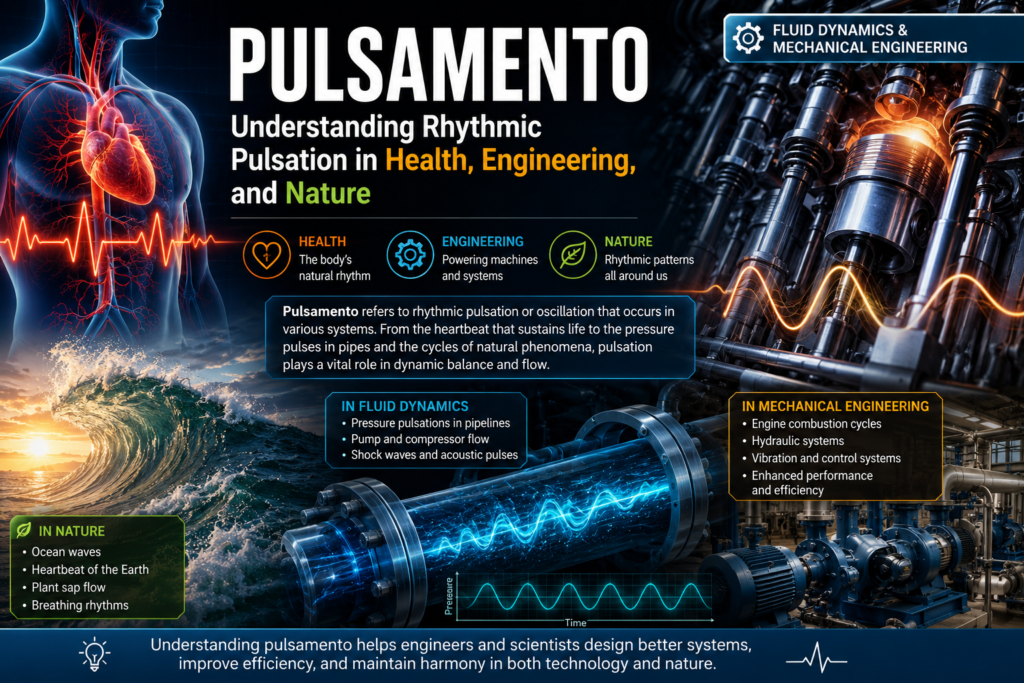
Outside of medicine, engineers study cyclic fluid patterns to keep machinery running smoothly and safely. In mechanical networks, uncontrolled fluid surges can destroy equipment if left unchecked.
| Feature / Aspect | Biological Systems (Arteries) | Mechanical Systems (Piping/Pumps) |
| Primary Driver | Cardiac muscle contraction | Reciprocating pumps / Compressors |
| Fluid Medium | Whole blood (Viscous, non-Newtonian) | Hydraulic oil, water, gas, or chemicals |
| Damping Mechanism | Vessel elasticity & tissue absorption | Pulsation dampeners & surge tanks |
| Common Issue | Aneurysms, high arterial resistance | Water hammer, pipe fatigue, joint leaks |
Managing Mechanical Vibration
When pumps push liquid through rigid pipes, each stroke creates a pressure spike. Without proper dampening, these continuous surges cause fatigue failure—microscopic cracks in metal joints and pipe walls caused by constant flexing.
To prevent catastrophic leaks, engineers install accumulation chambers (dampeners) filled with compressed gas. When a pressure wave hits the chamber, the gas compresses, absorbing excess energy and smoothing the fluid output into a steady stream.
ALSO READ: Weighted Vest for Walking Benefits What Really Works
How to Monitor and Balance Rhythmic Surges
Whether managing personal physical wellness or maintaining heavy machinery, monitoring cyclic variations helps prevent long-term wear and tear.
Establish a Baseline
Measure resting values regularly. For personal health, record your resting heart rate and blood pressure at the same time every morning. For machinery, log baseline vibration readings during normal operating temperatures.
Identify Trigger Events
Note when intensity spikes occur. Do throbbing sensations occur after consuming caffeine, during high stress, or after specific physical tasks? In machinery, do pressure spikes correlate with valve closures or pump speed changes?
Apply Corrective Measures
Incorporate lifestyle damping techniques such as deep breathing exercises, proper hydration, and restful sleep to calm hyper-reactive vascular responses. In mechanical contexts, adjust flow control valves or inspect dampening bladders for pressure loss.
Verify System Stability
Re-evaluate metrics after adjustments. If physical throbbing persists alongside dizziness or chest pain, seek immediate professional medical attention. If mechanical vibration remains high, perform a full acoustic resonance test.
Conclusion
Understanding pulsamento gives us insight into the complex fluid dynamics that govern both human health and industrial mechanics. By paying attention to regular rhythms—and recognizing when those rhythms become erratic—we can proactively protect our health and maintain our equipment before minor irregularities turn into serious problems.
FAQs
Is it normal to feel a throbbing pulse in your stomach?
Yes, it can be normal, especially for thin individuals or when lying flat on your back, as the abdominal aorta runs close to the spine. However, if you notice a sudden, severe, or new visibly expanding throb in your abdomen, you should consult a doctor to rule out underlying vascular conditions.
What is the difference between pulse rate and heart rate?
While closely linked, heart rate measures how many times the heart muscle contracts per minute, whereas pulse rate measures the physical pressure wave felt in peripheral arteries as blood moves through them. In healthy individuals, these numbers are usually identical.
Why do mechanical pumps cause pressure pulsations?
Reciprocating pumps use pistons or diaphragms that push fluid in distinct strokes rather than a continuous flow. Each forward stroke creates a sharp pressure peak, resulting in cyclic waves through the piping network.
Can stress cause heightened awareness of vascular throbbing?
Yes. Stress triggers the release of adrenaline, which raises heart rate and expands blood vessels, making the physical movement of blood much more noticeable in areas like the neck, temples, and fingertips.
For more updates visit: DAILY FRONT

Other Articles



[…] ALSO READ: Pulsamento Understanding Rhythmic Pulsation in Health, Engineering, and Nature […]