


You scan your last item. You tap “pay.” The machine spits out an error code nobody can explain.
Sound familiar?
A lot of Walmart shoppers know that feeling. Now, some of them are walking into stores where the self-checkout kiosks aren’t even there anymore.
Walmart self-checkout removal is one of the biggest retail stories of 2026. But most headlines oversimplify it. This is not one big company-wide shutdown.
It’s something smaller and more targeted: store-by-store changes, driven by theft, customer complaints, and a rethink of what checkout should look like.
Here’s what’s actually changing, where, and why it matters to you.
What Does “Walmart Self-Checkout Removal” Mean?
In simple terms: some Walmart stores are taking out self-checkout kiosks and bringing back staffed cashier lanes.
It started quietly. Then it became official.
March 2026: Walmart removed every self-checkout machine from its South Philadelphia Supercenter on Columbus Boulevard. Human cashiers took over.
A Walmart spokesperson told the Philadelphia Inquirer the change came after reviewing local shopping patterns. Customer and employee feedback played a role too.
April 16, 2026: Walmart announced something bigger. Over 650 stores across the U.S. will be remodeled during the 2026 fiscal year. About 20 new stores will open by early 2027.
Pennsylvania alone gets 32 remodeled stores. Four of those are in the Philadelphia area.
So Is Self-Checkout Disappearing Everywhere?
No. And this is the part most articles get wrong.
This is not a nationwide removal of every self-checkout lane. Only a small number of stores have fully removed self-checkout so far, including locations in:
- Shrewsbury, Missouri
- Cleveland, Ohio
- Parts of New Mexico
- Los Angeles, California
The 650-store remodel plan is broader than just cashiers replacing kiosks. Some stores are getting new layouts and updated technology. Others are actually getting more self-checkout, just powered by AI.
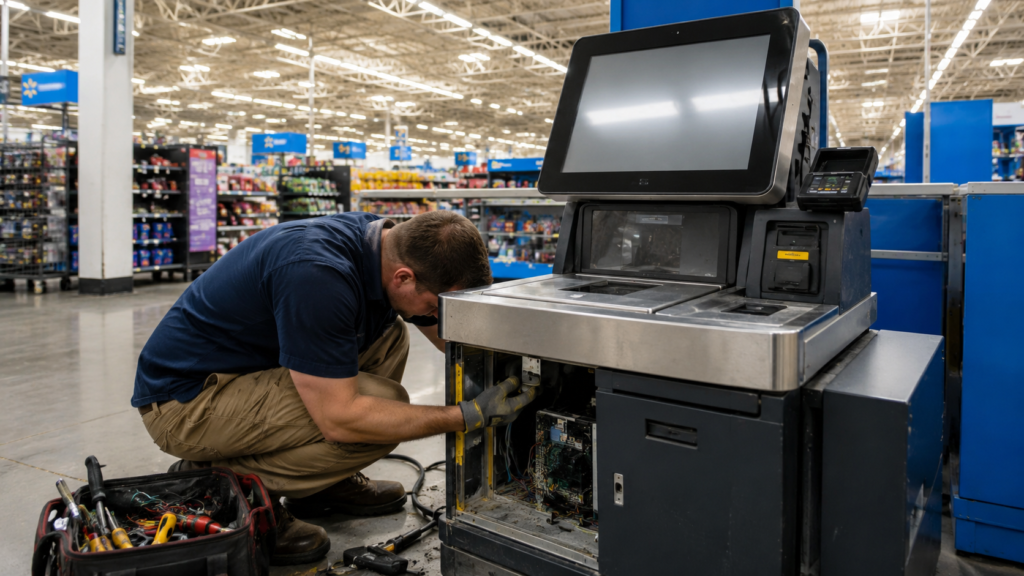
Why Is Walmart Removing Self-Checkout?
There’s no single reason. It’s a mix of factors, and the weight of each one changes from store to store.
1. Theft and Shrinkage
This is the reason that comes up most.
Unattended lanes make it easier to skip scanning an item, punch in the wrong produce code, or walk out without paying. Retailers call these losses “shrinkage.”
Here’s the clearest real-world proof: a Walmart store in Shrewsbury, Missouri.
| Metric | Jan–May 2024 | Jan–May 2025 |
|---|---|---|
| Police calls to the store | 509 | 183 |
| Arrests at the store | 108 | 49 |
The local police chief linked that drop directly to the store removing its self-checkout lanes.
Walmart has also reported significant company-wide losses tied to theft and scanning errors. Exact figures vary by source and reporting period, so we won’t pin down one “official” number here.
2. Customer Frustration
Self-checkout was supposed to be faster. For a lot of shoppers, it just isn’t.
Common complaints:
- Machines that can’t recognize produce codes
- The dreaded “unexpected item in bagging area” error
- Long waits for staff to clear an alert
- Fewer registers open, even during busy hours
3. Rising Costs
Grocery prices kept climbing through 2026. Food costs ran a few percentage points above the year before.
Some analysts believe financial pressure changes shopper behavior at checkout — including a rise in accidental and intentional non-scanning. Unstaffed lanes make that easier, right when retailers can least afford it.
4. New Local Rules
Several states and cities have introduced or discussed rules around self-checkout. Some limit how many unattended lanes a store can run. Others require visible staff supervision.
This is pushing retailers to make checkout decisions store by store, rather than waiting on one national rule.
Read more: Small Home Office Decorating Ideas That Actually Work
The Four Ways Walmart Is Changing Checkout
Here’s the full picture in one table:
| Approach | What It Means | Where |
|---|---|---|
| Full removal | Kiosks out, cashiers back | South Philadelphia; select stores in MO, OH, NM, CA |
| Restricted access | Self-checkout limited by hours or membership | Various test locations |
| AI-powered scanning | Kiosks stay, but items are recognized without manual barcode scans | ~30% of stores now, expanding toward 50% |
| Full remodel | New layout, tech, and navigation | Part of the 650-store 2026 plan |
Walmart’s checkout leadership confirmed the AI recognition tool is already live in about 30% of stores. It’s expected to expand further.
So this isn’t a retreat from technology. It’s a shift toward technology that actually reduces friction, instead of adding to it.
How Other Retailers Are Doing the Same Thing
Walmart isn’t acting alone. Here’s what other major chains have done:
- Dollar General pulled self-checkout kiosks from about 12,000 stores in 2024.
- Sam’s Club (a Walmart subsidiary) is phasing out traditional self-checkout in favor of “Scan & Go,” where members scan items on their phone as they shop and pay on the way out.
- Costco is testing a hybrid model — staff pre-scan cart items while you’re still in line.
- Target and Five Below have both scaled back self-checkout at select stores.
The pattern is clear. Retailers are landing on the same conclusion: fully unattended checkout, at scale, created more problems than it solved.
The fix isn’t “bring back only cashiers everywhere.” It’s finding the right mix — staffed lanes, supervised self-checkout, and app-based scanning — for each store’s specific situation.
What This Means for You as a Shopper
Quick, practical takeaways:
- Check before you go, if you rely on self-checkout for fast trips. Availability now varies a lot by location.
- Expect more cashiers at stores flagged for high theft or lots of complaints.
- Expect smarter self-checkout, not less of it, at stores getting the AI upgrade.
- Expect longer waits during busy hours at fully-converted stores, at least until staffing catches up.
- Expect more changes through the rest of 2026. This rollout isn’t finished.
The Bigger Picture
This isn’t Walmart rejecting automation.
It’s Walmart admitting that one-size-fits-all self-checkout didn’t work the same everywhere. Some stores handled it fine. Others became a steady source of theft and frustration.
Walmart’s answer: treat checkout as a local decision, not a single company-wide rule.
That’s a more balanced approach than either extreme — self-checkout everywhere, or nowhere. It also means this story isn’t over. Expect more store-specific updates as the 650-store plan continues through 2026, not one big final announcement.
Frequently Asked Questions
Is Walmart getting rid of self-checkout everywhere?
No. Walmart is removing it at select stores with high theft or complaints, while expanding AI scanning tech at others. It’s store-by-store, not nationwide.
Which Walmart stores have already removed self-checkout?
Confirmed so far: South Philadelphia (Columbus Boulevard), Shrewsbury (Missouri), Cleveland (Ohio), parts of New Mexico, and Los Angeles (California). More are expected as the 650-store plan continues.
Why is Walmart removing self-checkout machines?
Mainly theft and shrinkage, customer frustration with kiosk errors, rising costs, and new local rules on unattended checkout.
Will Walmart bring back more cashiers?
Yes, at stores where self-checkout is fully removed. Walmart says it’s also investing in employee training as part of the remodel.
Are other stores doing this too?
Yes. Dollar General removed self-checkout from about 12,000 stores in 2024. Sam’s Club is moving to app-based Scan & Go. Costco is testing hybrid checkout. Target and Five Below have scaled back self-checkout too.
Does removing self-checkout actually reduce theft?
Early evidence says yes, at least in one case. Police calls and arrests both dropped at a Shrewsbury, Missouri Walmart after it removed self-checkout. That’s one store’s data though, not a nationwide study.
For more updates visit: Daily Front







[…] People can also read this: Walmart Self-Checkout Removal What’s Really Happening in 2026 […]